What size boiler a Louisiana home needs

A local installer who puts in boilers gets your project.

Find a pro near me

What size boiler do I need for my Louisiana home?

Most Louisiana homes run on electric heat, so boilers show up less here than furnaces and heat pumps. If your house does have one, or you're putting one in, you want a number that fits, not a guess that leaves you cold on the rare freeze or paying for capacity you'll never use.

Size comes from a heat loss calculation, not your square footage

A contractor sizes a boiler by figuring out how much heat your house actually loses on a cold day, room by room. That depends on your windows, your insulation, your ceiling height, and how the walls are built, not just the square footage of the floor plan. Louisiana winters are mild compared to most of the country, so the load is usually smaller than a similar house further north would need. A boiler sized too big will short cycle and wear out faster. One sized too small will run constantly on the handful of cold nights you get and still fall behind. Getting the number right matters more here than the climate might suggest, because the margin for error is thinner on a mild-winter system.

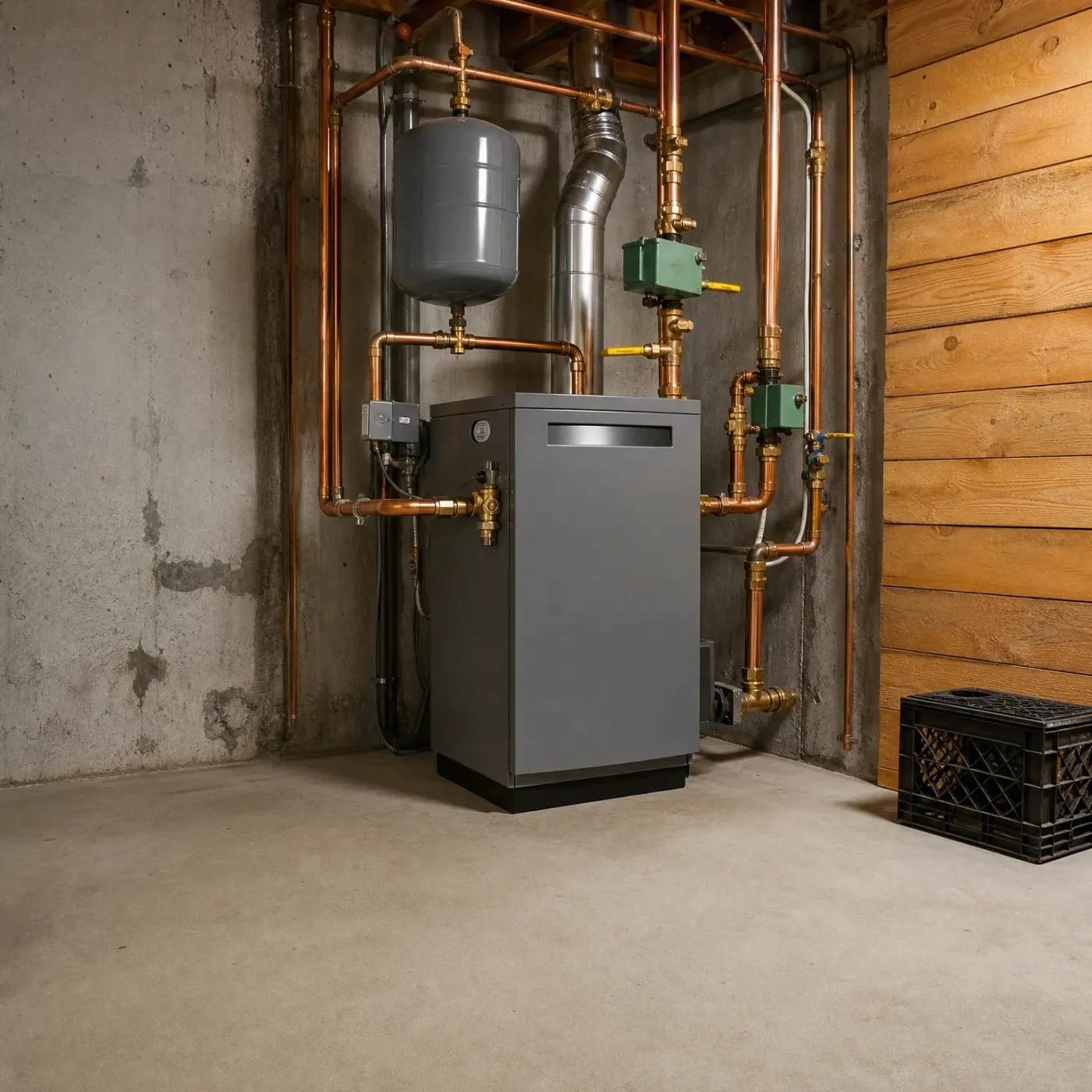
A gray boiler unit on a concrete pad in a basement corner, connected to copper piping, valves and a metal flue against painted concrete block walls.

Sized right, it runs quiet

A boiler matched to your house heats evenly without short cycling. The pipes and fittings stay dry, the pressure holds steady, and the unit kicks on, does its job, and shuts off. No banging, no rooms that never quite warm up.

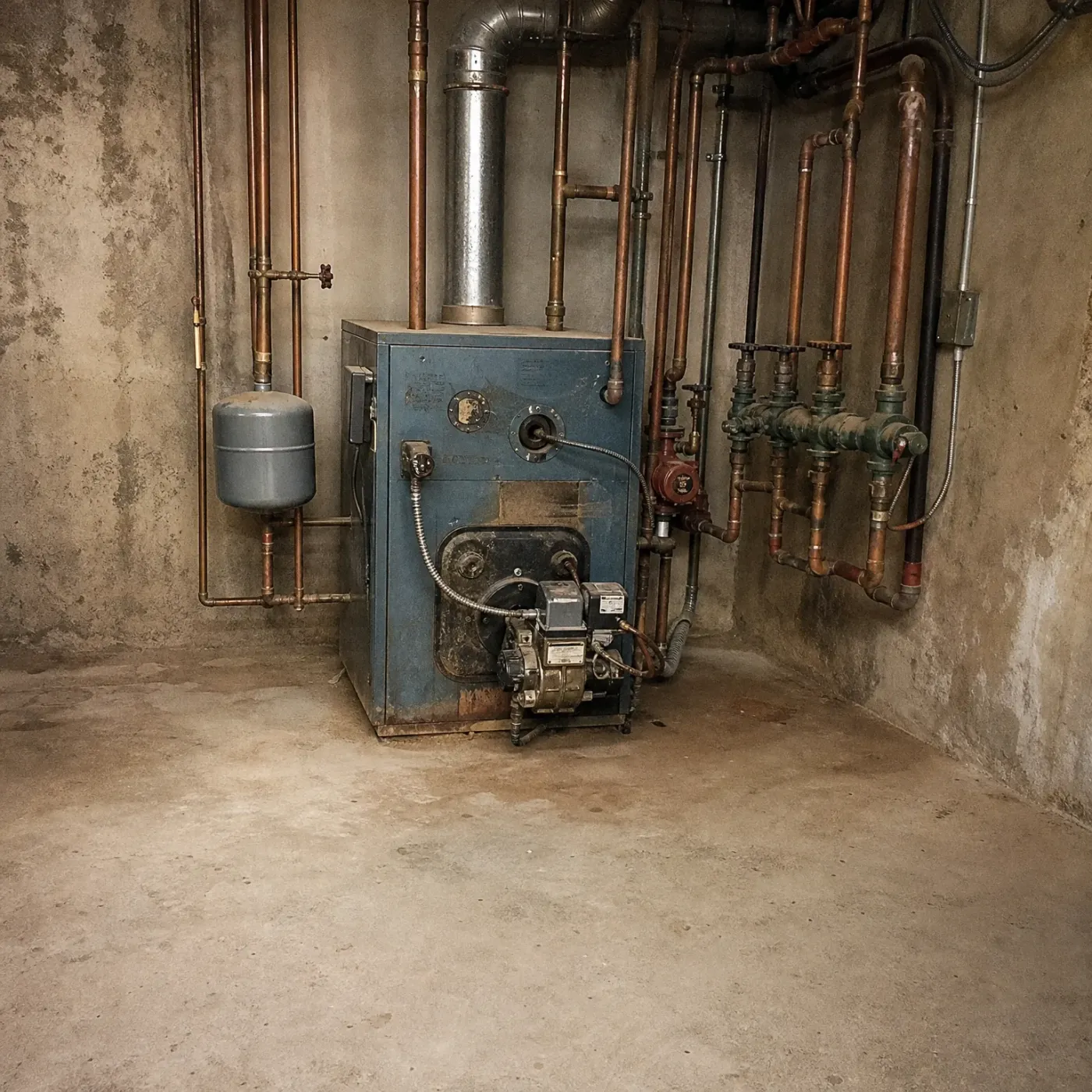
A blue oil-fired boiler with a burner unit sits on a concrete pad in a basement corner, with copper piping, valves and a gray expansion tank overhead against concrete block walls.

Sized wrong, it shows

An oversized or undersized boiler wears differently. Some rooms run cold while others overheat. The unit cycles more than it should, and parts under that kind of strain tend to fail sooner than they're built to.

Is your boiler the wrong size for your house

A boiler that's too big will heat the room fast, shut off, and leave the floor and the pipes cold again within minutes. You'll hear it cycle on and off all evening and feel drafts even with it running. One that's too small never seems to catch up. The thermostat says it's working, but a back bedroom or a far end of the house stays cool, and it runs long stretches without shutting off. Either way the boiler works harder than it should, and that wear adds up, on the burner, the pump, the fittings. With most Louisiana homes heating with electricity, a boiler here is usually an older install or a replacement, so the sizing that was right for the last one may not fit what the house needs now.


A woman with long gray hair wrapped in a checked blanket sits on a sofa by a window with yellow autumn foliage outside, with a lamp, framed picture and plant in the background.
An older woman in a cream knit sweater sits on a sofa by a window, looking out at sunlit trees with yellow and orange autumn leaves, with a bookshelf and lamp behind her.
A woman with gray shoulder-length hair in a dark knit sweater sits on a cushioned seat by a window, looking out at yellow autumn foliage, with a living room, armchair, houseplant and framed picture behind her.
An older woman with gray hair in a bun, wearing a cream knit sweater, sits on a sofa with a gray blanket and looks out a large window toward yellow-green autumn trees, with a lit table lamp and dark armchair behind her.

Oversized vs. Undersized Boiler

Oversized

  • Short cycling wears out the igniter and the circulator pump faster than normal use would.
  • The boiler reaches setpoint so quickly that the thermostat satisfies before heat reaches the far rooms.
  • Gas and electric costs run higher since the burner fires more often per hour than it needs to.
  • Condensation can form inside the heat exchanger when cycles are too short to burn it off.
  • Pipes and fittings see more thermal stress from constant heating and cooling swings.

Undersized

  • The boiler runs long stretches trying to reach setpoint, especially on the rare cold snap Louisiana gets.
  • Rooms farthest from the boiler stay noticeably cooler than rooms close to it.
  • The unit runs near its limit most of the time instead of cycling normally, which shortens its life.
  • Recovery takes longer after any setback, so mornings feel colder than they should.
  • Fuel use climbs because the burner stays on far longer per degree of heat delivered.
An older blue boiler with a burner unit stands in a concrete basement corner, connected to copper and steel piping, valves and a gray expansion tank on the wall.
Before you get your boiler installation
A gray boiler unit in a basement corner with copper piping, brass valves, a gray expansion tank, a metal flue duct, concrete walls and a wood-paneled wall, with a black plastic crate on the floor at right.
After you get your boiler installation

A boiler pro near you

A boiler that's the wrong size doesn't fix itself, and it keeps costing you until someone swaps it for the right one. Since boilers aren't the common setup in Louisiana, finding a contractor who actually sizes them correctly instead of guessing off square footage alone takes more than picking the first name you find. That matters here because an undersized or oversized unit shows up in your gas or electric bill every month it runs, even with power as cheap as it is in this state. A contractor who does a proper heat loss calculation for your house, your rooms, your windows, will land on a number that fits your home instead of a nameplate number that fits nobody. You've already seen what the wrong size costs you in comfort and wear. Getting the right one in means handing that question to someone who sizes boilers for a living, and letting them work out what your house actually needs.

Boiler sizing runs on a heat loss calculation, the BTUs your house loses on the coldest night, figured room by room from wall area, window count, and insulation.

Square footage alone skips all of that, which is why two houses the same size can need different boilers. A contractor who runs the calculation gets you the right one the first time.

A woman in a cream knit sweater sits in an armchair with her eyes closed and a slight smile, beside an open window showing orange autumn foliage, with a mug, books and a lit candle on a small side table.
An older man with gray hair and a beard leans back on a beige sofa with his eyes closed, in a sunlit room with potted plants, a wicker chair and large windows behind him.

Replacing a boiler that's already there

If the boiler you have now is the one that came with the house, whoever sizes the new one should still run the calculation rather than match the old unit's output. Boilers get replaced with the wrong size more often than people expect, especially when the job is quoted fast and the installer just copies the nameplate number. If the old one short cycled or ran long to catch up, that's a sign it was never sized right to begin with. A heat loss calculation on the replacement is how you avoid installing the same problem twice, in the same walls, with the same rooms that never felt right.

Adding a boiler where there wasn't one

If you're putting in a boiler for the first time, maybe alongside electric heat or in a space it didn't reach before, there's no old unit to go by at all. The calculation has to account for the rooms it's actually meant to cover, not the whole house, unless that's the plan. A contractor sizing this correctly will ask what the boiler needs to heat and figure the BTUs for that space specifically. Guessing here has no fallback to correct against, since there's no history of how an undersized or oversized unit behaved in that spot before.

Winter nights average 43°F statewide

A 43°F night is a mild load, not a deep freeze. If a contractor sizes your boiler for far colder nights than your house actually sees, you'll pay for capacity it rarely needs and never gets the benefit of.

NOAA nClimDiv 1991-2020 county normals weighted by homes

A boiler sized to your house, not just its square footage, heats evenly and holds its pressure where it should. That's the number worth having before any unit goes in, whether it's your first boiler or a swap for one that never fit right. Getting there means a heat loss calculation done for your rooms, your windows, your walls, not a guess made from a spec sheet. You don't have to run that calculation yourself or know which contractor around here still does it properly. Send in what you know about your house and a contractor who sizes boilers correctly for Louisiana homes will follow up directly. From there it's their work to measure, calculate, and recommend the unit that fits. You've done the part that matters, which is asking for the right number instead of settling for a guess.

A single-story stucco house at dusk with a lit paver walkway lined by low path lights, desert plants and boulders in front, and distant mountains under an orange and blue sky.

Boiler Installation

A local pro for your boiler installation

Step 1 of 3: Equipment
  • A brown leather and wood armchair with a cream knit throw sits in a corner beside a woven basket holding a dark cushion, under a framed mountain photograph, with a wood-trimmed window showing yellow and green foliage.
    • A local pro who knows boilers gets your details and gets in touch.
    • Describe your boiler job, and a local pro who handles it gets in touch.
  • A dark wood dresser against a pale wall holds a ceramic vase of eucalyptus branches, a stack of books with a wooden bowl, and a woven basket, with a framed landscape painting above and a woven basket holding a knit blanket on the floor beside a window.
    • Send the form and the search for an installer is over.
    • Send the request and finding a pro stops being your problem.
  • A window seat with beige linen and brown textured cushions, a chunky knit blanket, and an open book, beside a window showing blurred yellow autumn foliage.
    • Skip collecting and comparing quotes for the new boiler.
    • Skip the round of in-home estimates for a new boiler.
  • A cream upholstered armchair with a rust-colored pillow and knit fringed throw sits beside a window with a ceramic vase of orange-leafed branches on the sill, overlooking autumn trees and leaf-covered ground.
    • One installer gets your project, so there's no bidding war over it.
    • Only one pro gets your request, so you hear from one company.